Start your journey here
- Consider why you might go on a pilgrimage. To connect with your past? To commune with the divine? To anchor yourself in this world? To celebrate a festival with far-away friends?
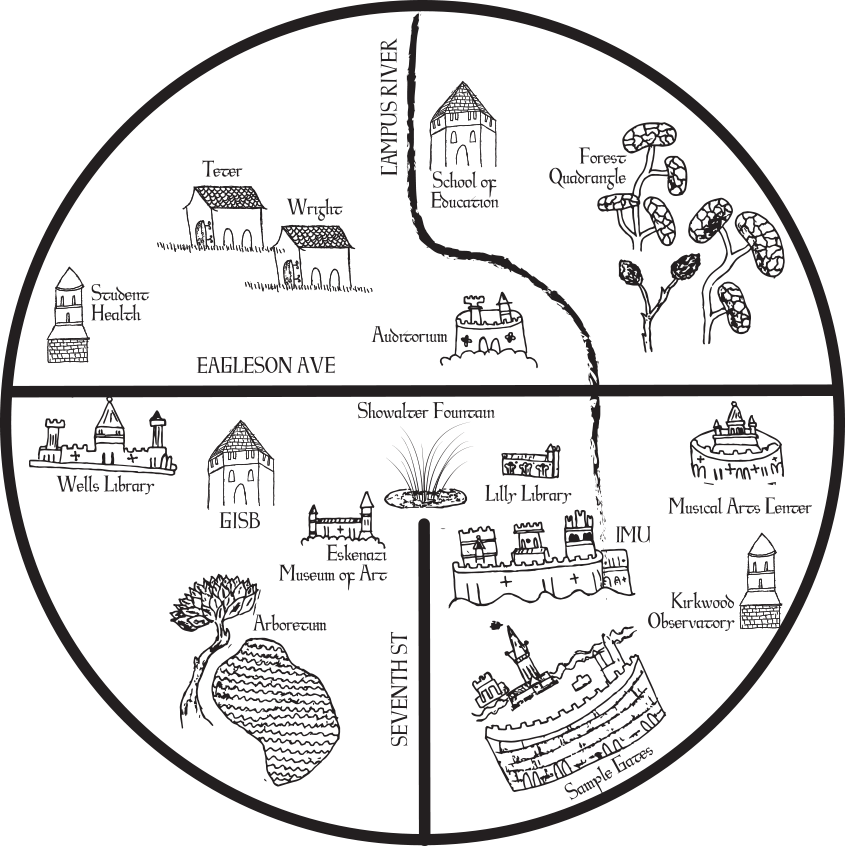
- Pick up a map of campus adapted from medieval Mediterranean T-O maps and use the latitude and longitude information on this page to help you find your way through your campus pilgrimage.
- Explore and mark your chosen pilgrimage sites. Mark your pilgrimage sites with a stamp, and see how the medieval T-O map aligns with your real-world geography (zoom out a bit if you’re on a smartphone).
- Commemorate your pilgrimage by taking a selfie or a photo. Take a selfie at your favorite pilgrimage site or a photo of your completed pilgrimage map.
About the T-O Map
This three-part map of the world represented Asia taking up the top of a circle (the section of the “O” above the crossbar of the “T”). Europe was positioned on the bottom left of the map and Africa on the bottom right of the map. Examples of the T-O Map can be found between the 6th century and the 16th century all over the medieval Mediterranean, including in the works of scholars like 7th century Isidore of Seville (folio 123v in the Harley manuscript #2660 at The British Library) and 14th century historian ibn al-Wardi (folio 3v/4r in UPenn LJS 495), whose atlas is more detailed but still hews to the T-O shape.
The stickers provided to mark IUB pilgrimages are from medieval Arabic astrolabes, used to make astronomical measurements. The circular motif is from al-Sijzī, Abū Saʿīd Aḥmad ibn Muḥammad. Fī ʿamal Al-Aṣṭūrlāb (On the Construction of Astrolabes; folio 148r). The pointed marker is an Astrolabe star-pointer for Regulus with Arabic and Armenian inscriptions (Syria?, Early 10th c. CE?; in the Oxford history of Science Museum).
This T-O Map, which uses Indiana University Bloomington as its 21st-century base, was illustrated by Emily Clark, an art historian, using a font adapted from the hand used in the Exeter Book (10th century England, Exeter, Cathedral Library, MS 3501)
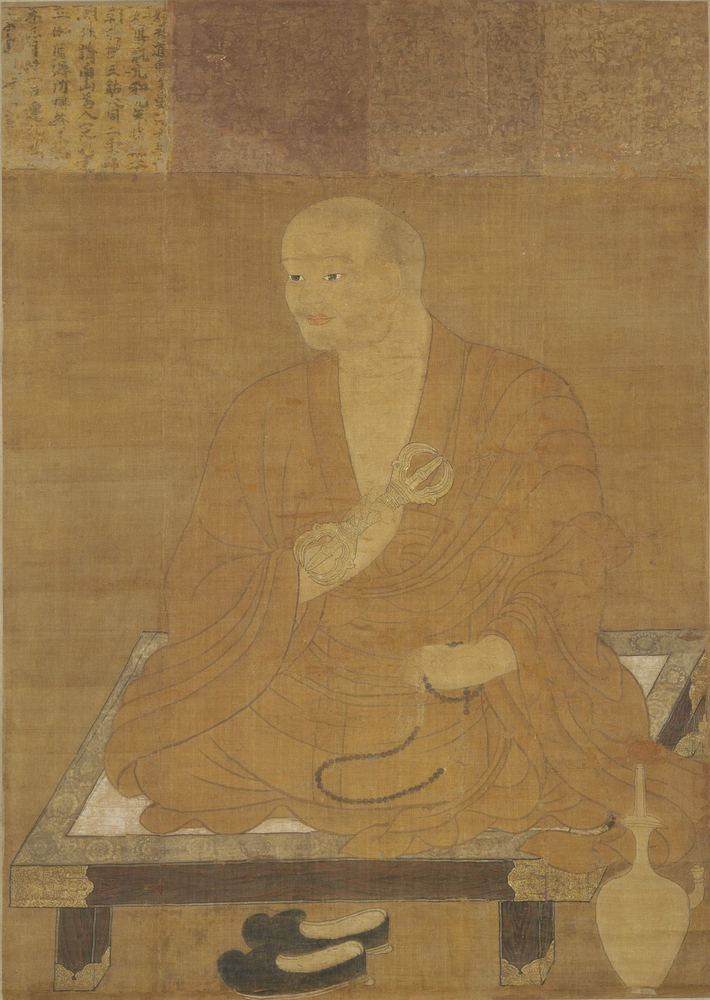
Travel a Forested Path
Rain or shine, members of our community follow these tree-lined labyrinthine paths with the presence of the first holy person to walk these routes guiding them. Whether they observe the... (read more...)

Seek a Wise Counselor
IU students seek wisdom from people most often trained in the studia humanitatis (i.e. humanities). Such counselors offer advice on the wisdom amd what classes to take and what subjects... (read more...)

Join a Festival of Nations
Students, visitors, and staff meet at these sculpted grasslands near a central river to enjoy performances together, celebrate holidays, and enact communal rituals. Because of their location right in the... (read more...)

Falling Waters Mark a Festival and the Start of a Pilgrimage
Festivals and pilgrimage sites go together like fish in water. Bonus: there's almost always a marketplace with food stalls and fun activities nearby! (read more...)
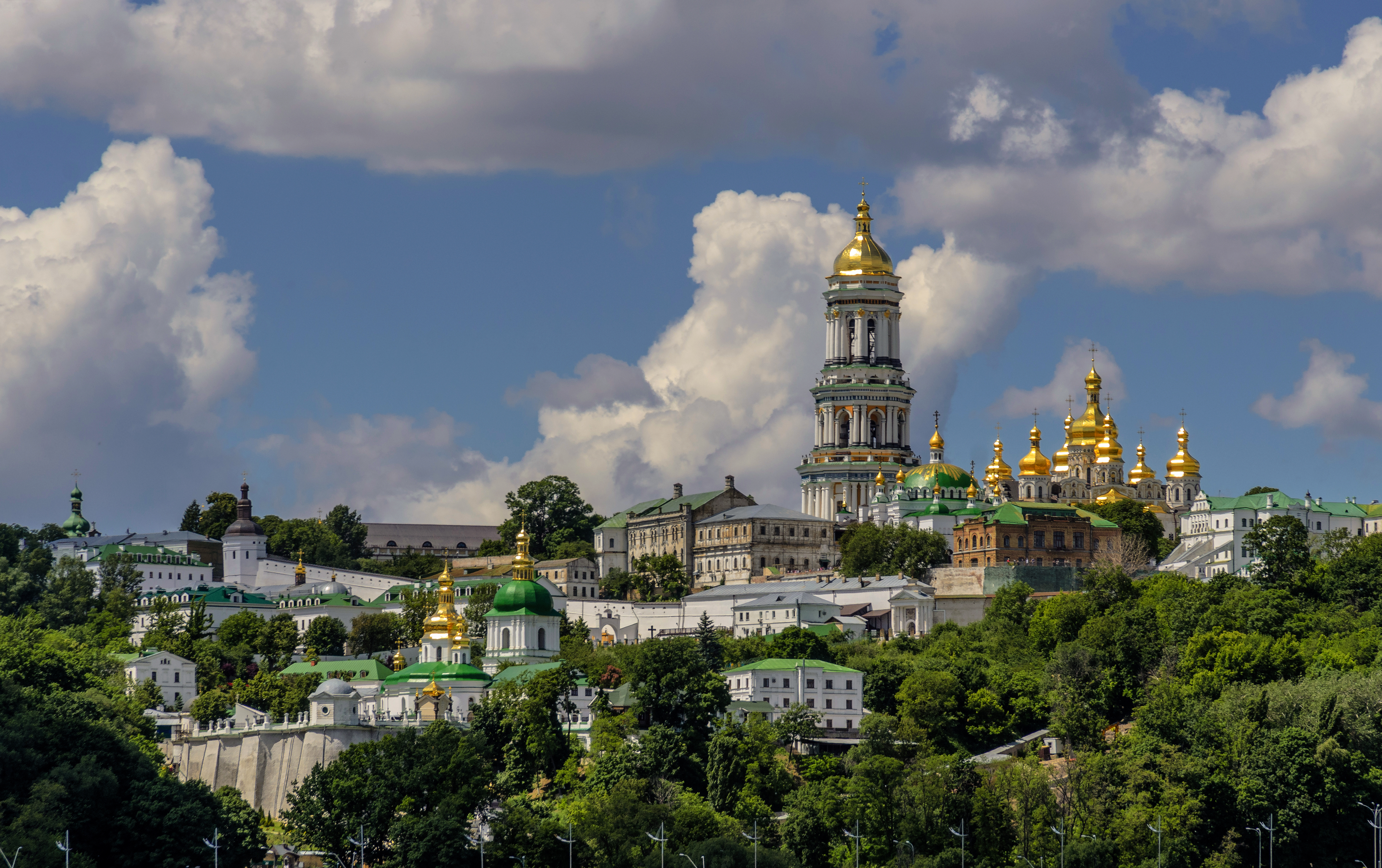
Venture into the Depths of Mother Earth
This IUB landmark is very bright, big and showy on the outside. It has so many different additions and construction phases that visitors get lost very quickly above ground, and... (read more...)

Visit a famous healer
The IU community flocks here for the laying on of hands. Holy men and women here cure minor chronic illnesses like fevers and joint pain as well as acute illnesses... (read more...)