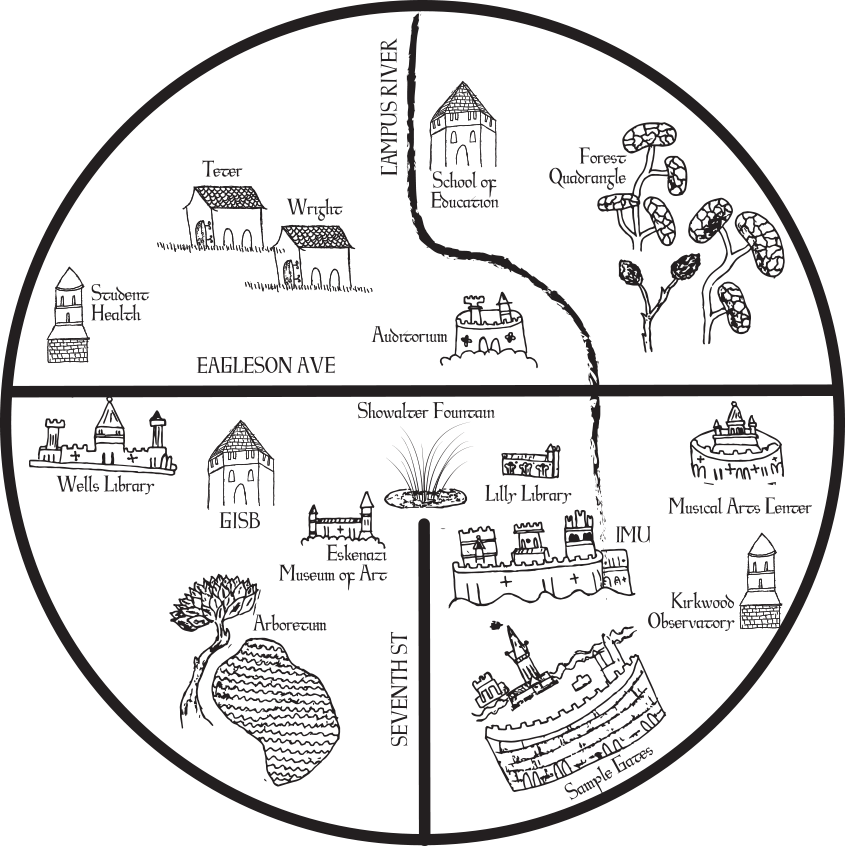
Morten Oxenboell
East Asian Languages and Cultures, Indiana University
Find me at the bench in the center of Dunn’s Woods.
Rain or shine, members of our community follow these tree-lined labyrinthine paths with the presence of the first holy person to walk these routes guiding them. Whether they observe the nature of beauty in isolation or seek the spiritual company of fellow travelers, each pilgrim crosses a boundary from the bustle of the brick-lined paths of the outside world into a quiet, contemplative forested preserve.
The medieval parallel
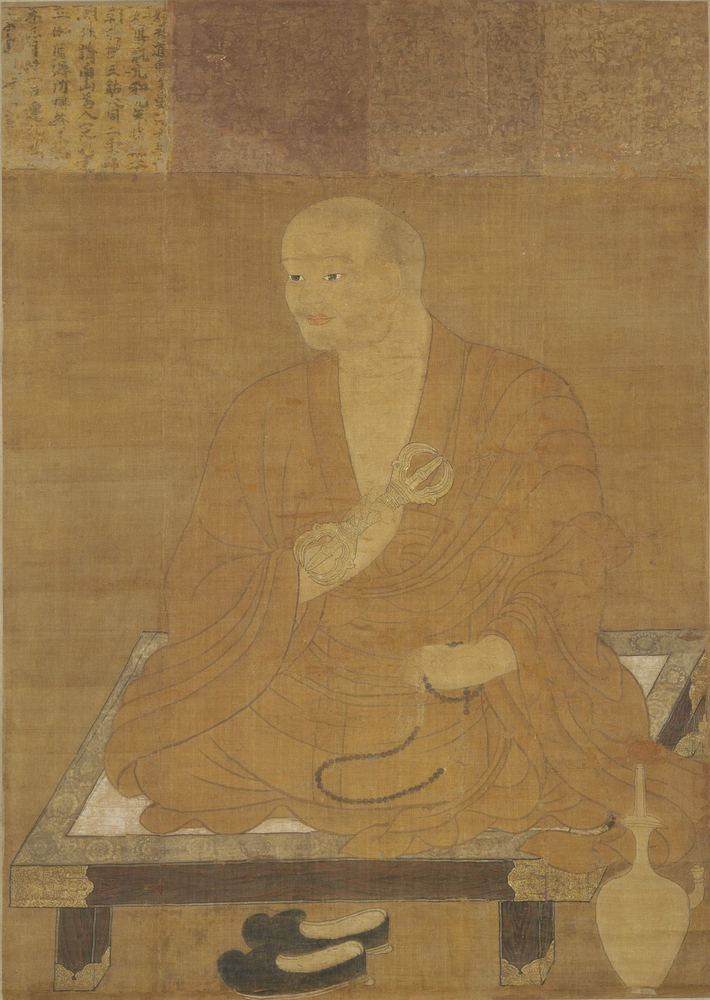
Buddhist priest Kūkai was born Saeki no Mao (Mao, of the Saeki family) on the island of Shikoku in Japan. His early studies led to a life of ascetic and meditative practices as a Buddhist and an administrator in 9th century Japan. His writings on Buddhism in the Japanese tradition led to his other name, Kōbō Daishi, or “Great Teacher”.
The Shikoku Henro, or Shikoku pilgrimage, is a circular pilgrimage to 88 sites on Shikoku associated with Kūkai’s 9th-century life; much of the path is forested and offers contemplation of both the natural world and Kūkai’s Buddhist teachings. A collection of folksongs from 12th-century Japan, the Ryojin Hisho, mentions the Shikoku pilgrimage among a number of other pilgrimages. One poem laments the winter pilgrimage and the trees that lose their leaves:
The mountain ascetic suffers the austerity of winter: his house of trees has lost. (RH 305)
By the 16th century, 88 specific sites had emerged as a pilgrimage tradition that lives on today.
- Kim, Yung-Hee. Songs to Make the Dust Dance: The Ryojin Hisho of Twelfth-Century Japan. Berkeley, CA: University of California Press, 1994. http://ark.cdlib.org/ark:/13030/ft2f59n7x0/
Find someone near you who can help you learn more
- Take a course on medieval Japan with Professor Morten Oxenboell (East Asian Languages and Cultures)
- Find out more from Professor Heather Blair (Religious Studies), whose current project Reverently I Pray looks at patronage networks and prayer in medieval Japan