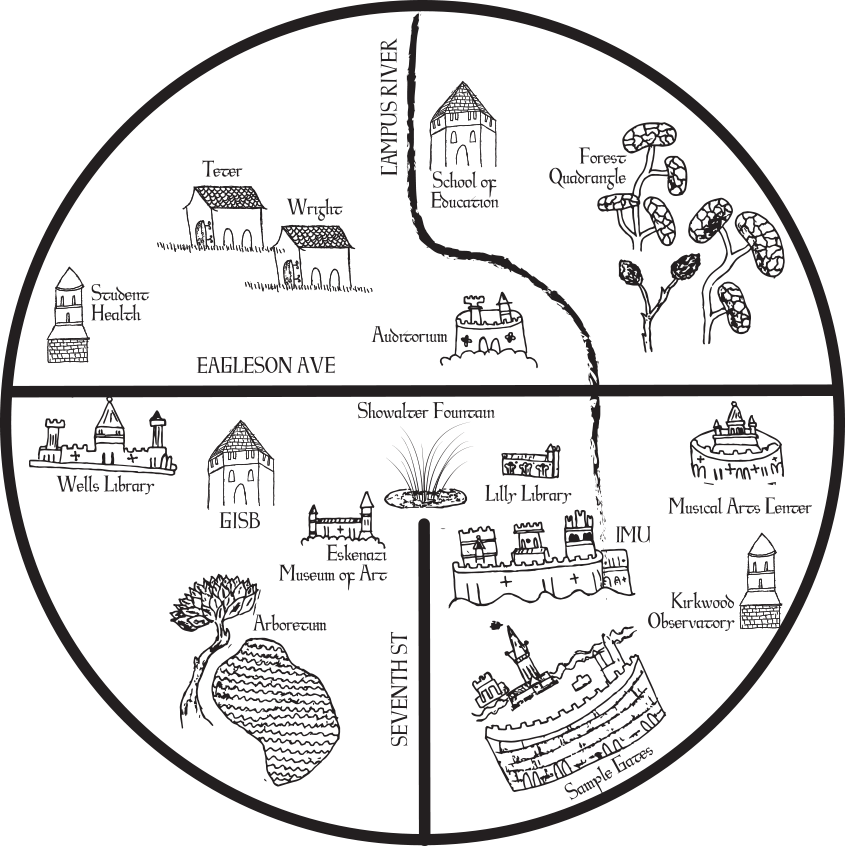
Find me where the newly renamed-campus river meets the western edge of the IMU.
Students, visitors, and staff meet at these sculpted grasslands near a central river to enjoy performances together, celebrate holidays, and enact communal rituals. Because of their location right in the middle of everything, this site is home to many different people at different times of the year, and open to all who may pass through.
The medieval parallel

The Cahokia Mounds, located in the Bottom Region (near Collinsville, Illinois, in the Mississippian Southeast region of the United States), was home to one of the greatest cities in the world. The Cahokia urban area served as a gathering place for a vast community of indigenous Native Americans from the 8th to the 14th century and, at its peak between 1000 and 1200 C.E., was larger than contemporary London. Cahokia served as a home, and as a ritual and festival ground, for 20,000 people. Crowds filled its Grand Plaza and visitors marked the winter and summer solstice at Cahokia’s Woodhenge, an installation designed for astronomical observation.
Its largest earthen structure, Monks Mound, is roughly the size of the Great Pyramid at Giza, covering 15 acres at its base (a larger area than Dunn Meadow). Equally impressive are the new forms of material culture — including new pottery forms and markedly new uses for those new pottery forms — that resulted from Cahokia’s development into a central gathering space for people from many Native American nations. Examples of Cahokian pottery have been found all across the middle of North America, from the upper Midwest to the lower South, suggesting the importance of Cahokia as both a gathering destination for, and an influence on, a huge swath of North America.
Find someone near you who can help you learn more
- Find out more about Cahokia from Professor Susan Alt (Anthropology), who researches the Cahokia Mounds
- Take ANTH-P361: The Prehistory of the US
- See how research scientist William Monaghan at the Indiana Geological and Water Survey (IGWS) maps the Cahokia Mounds contours for preservation and research