Nicolò Sassi
Theological Studies, St. Louis University
Find me in GISB 1028
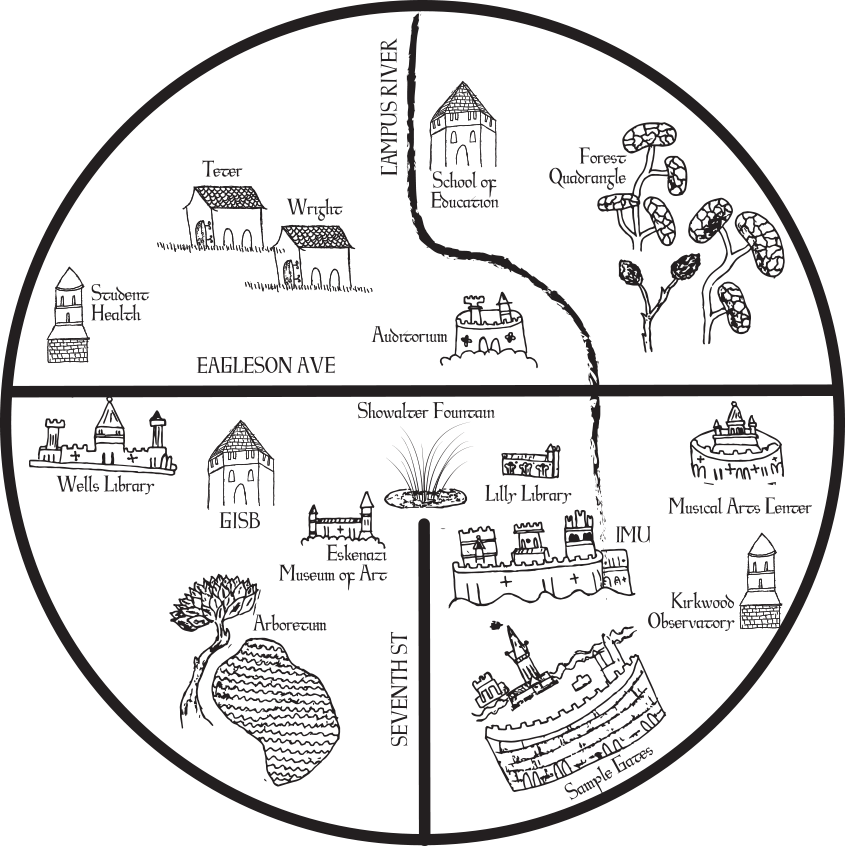
IU students seek wisdom from people most often trained in the studia humanitatis (i.e. humanities). Such counselors offer advice on the wisdom amd what classes to take and what subjects to explore, can be found all across campus. Seek the most wise counsel for Medieval Studies in the 28th room of the first floor in a shimmering building, made of equal parts glass and stone, near the limestone monolith at the top of the highest hill.
The medieval parallel

Between the end of the sixth and the beginning of the seventh century, Byzantine monk John Moschos and his friend Sophronius undertook a long pilgrimage to meet the ascetics and wise men of the Eastern Christian world. Their last stop was the monastery of Deir ul-Muharraq.
Travelling from Syria through the deserts of Palestine, Egypt, and Libya, John and Sophronius encountered many monks and hermits who offered them wisdom in the form of stories. John recorded all these stories — from the adventurous to the hilarious to the awe-inspiring and thought-provoking — in a rich collection describing his travels called Spiritual Meadow:
Someone among the fathers told that one of the elderly ones, who was pure and saint, when he “did the proskomide” (i.e. celebrated Mass) saw angels staying at his right and at his left. He had taken over the “proskomide” from the heretics, and since he was ignorant about divine doctrines, he said the words of the offering in simplicity and innocence, not knowing that he was wrong. By providence, some brother, an expert in divine doctrines visited him. It came to pass that the old man made the offering in his presence. The brother said to him (he was a deacon): The words you said for the proskomide, Father, are not of the orthodox faith, but of the bad doctrine. The old one, since he saw angels during the offering, did not pay attention to what was said, but disdained it. The deacon insisted saying “You are in error, good old one, the Church does not accept this”. The old man, seeing that he was accused and blamed in that way by the deacon, saw the angels as usual and asked them: “Since that deacon talks to me in such a way, what is it that he says?” The angels said: “Listen to him: he says the truth”. The old one said to them: “And why did not you tell me that?” They said to him: “Because God disposed thus, that humans should be corrected by humans”. And since then he corrected himself and thanked God and the brother.
Find someone near you who can help you learn more
- Take a course on John Moschos, monasticism, and travel literature in late antiquity and the medieval Mediterranean with Professor Jeremy Schott or Professor Daniel Caner (Religious Studies)
- Find the Medieval Studies Academic Advisor, Dr. William Smith, at GISB 1028


.jpg)