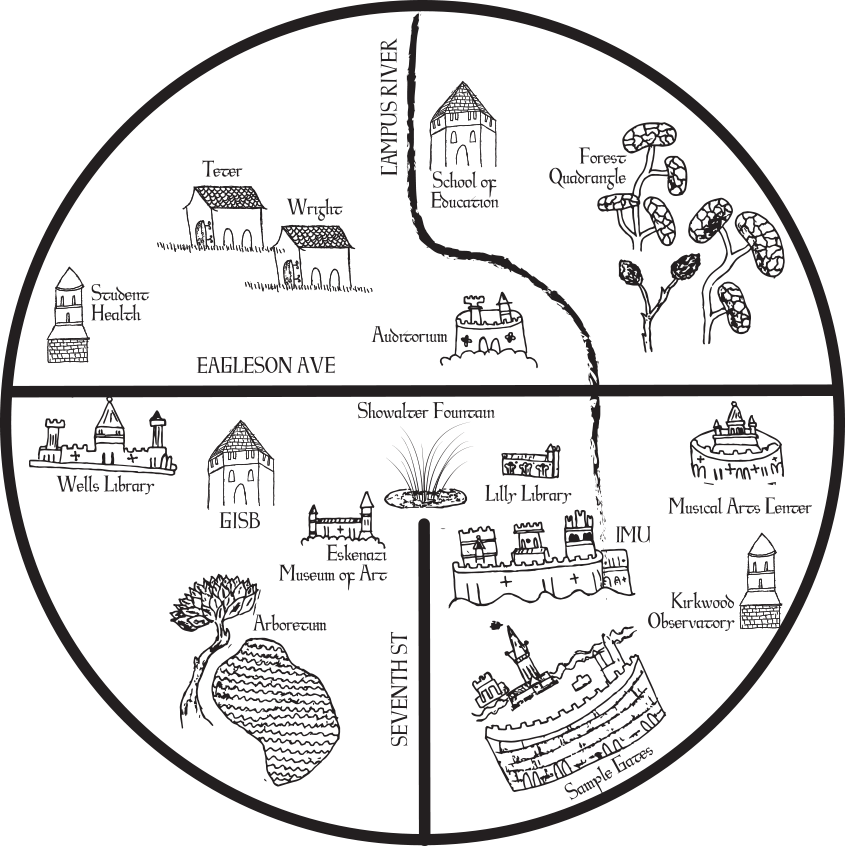
Find me at the IU Health Center’s drive-in gate.
The IU community flocks here for the laying on of hands. Holy men and women here cure minor chronic illnesses like fevers and joint pain as well as acute illnesses and serious injuries, but it’s uphill both ways and you have to get past the keeper of the shrine first.
The medieval parallel

The Shrine of St. Martin of Tours (47.3946308,-38.3422852) Late 6th-century pilgrims from all over the Mediterranean came to a small shrine in Tours (what is now France) to heal their chronic and acute illnesses at the Shrine of St. Martin. Gregory of Tours, Bishop of St. Martin and author of a number of St. Martin’s miracle stories, was himself healed through prayer at the tomb of St. Martin. He writes about it in The Four Books of the Miracles of St. Martin
Whenever headache comes on or a throbbing in the temples or a dulness of hearing or a dimness of sight or a pain attacks some other part, I am cured at once when I have touched the affected part on the tomb or the curtain hanging before it and I wonder within myself that at the very touch the pain is immediately gone. I shall place first in this book a miracle that I experienced recently. We were sitting at dinner after a fast and eating, when a fish was served. The sign of the cross of the Lord was made over it, but as we ate, a bone from this very fish stuck in my throat most painfully. It caused me great distress, for the point was fastened in my throat and its length blocked the passage. It prevented my speaking and kept the saliva which comes frequently from the palate, from passing. On the third day, when I could get rid of it neither by coughing or hawking, I resorted to my usual resource. I went to the tomb and prostrated myself on the pavement and wept abundantly and groaned and begged the confessor’s aid. Then I rose and touched the full length of my throat and all my head with the curtain. I was immediately cured and before leaving the holy threshold I was rid of all uneasiness. What became of the unlucky bone I do not know. I did not cough it up nor feel it go down into my stomach. One thing only I know, that I so quickly perceived that I was cured that I thought that some one had put in his hand and pulled out the bone that hurt my throat. (Book 3; Preface & Chap 1)
The skull of St. Martin (courtesy of Wikimedia Commons)